
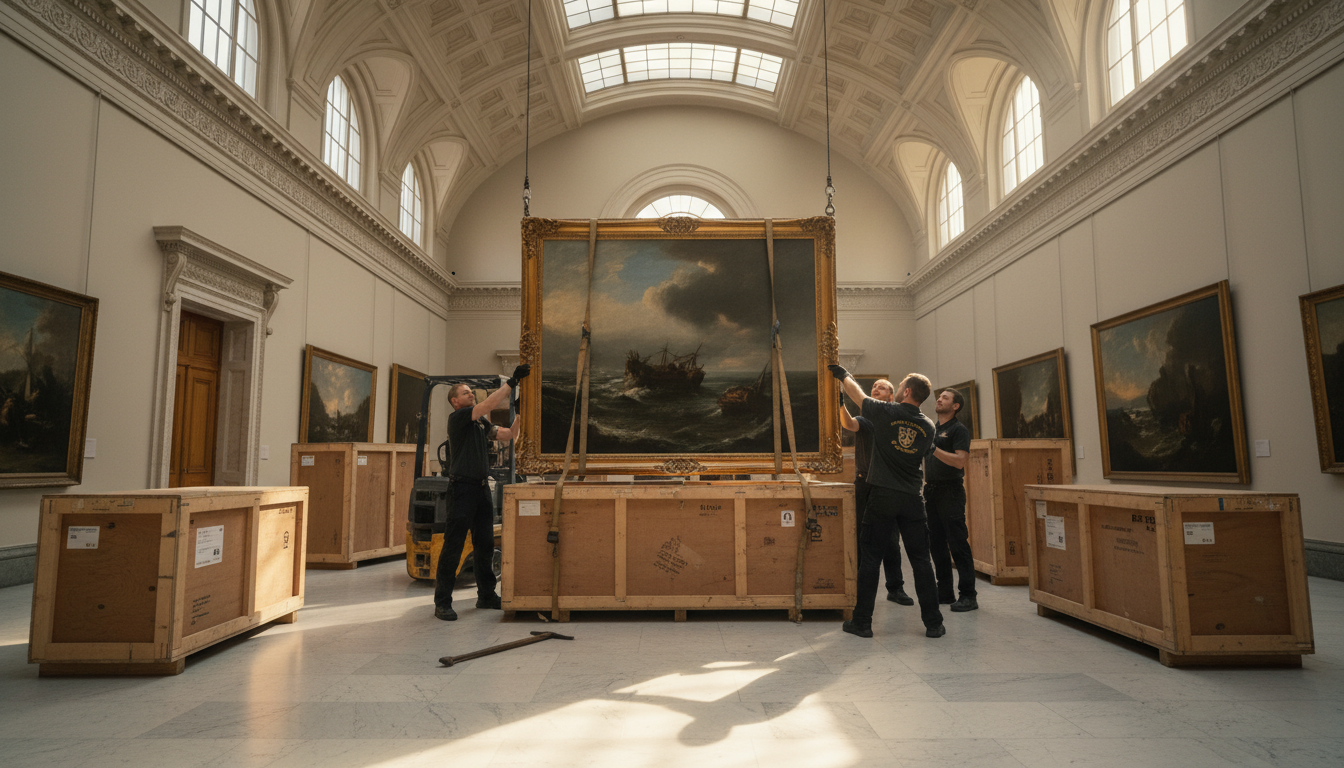
For decades, the British art market thrived on the frictionless movement of culture across the English Channel. An enthusiast could spot a mid-century canvas in a Parisian flea market, bundle it into the back of an estate car, and drive it home to London without a second thought for paperwork.
That era has ended. Since the United Kingdom left the EU Single Market and Customs Union, the border has thickened. For the Art Enthusiast—whether you are a fledgling collector, an interior design aficionado, or simply a lover of beautiful things—buying art from Europe is now legally identical to buying art from New York or Tokyo.
However, do not let the headlines scare you away from international collecting. While the administration has increased, the UK remains one of the most tax-efficient places in the world to import art. The secret lies in understanding the “Golden 5%” rule and navigating the logistics before the courier knocks on your door.
This guide is your definitive roadmap. We will strip away the dense legal jargon of HMRC and provide you with a practical, step-by-step strategy to importing art without getting stung by unexpected costs.
The New Reality: Imports, Exports, and Borders
Before we dive into the calculations, we must establish the fundamental shift in status. In the eyes of HM Revenue & Customs (HMRC), there is no longer a distinction between an antique bought in Provence and a sculpture bought in Shanghai. Both are “Third Country” imports.
When an artwork crosses the UK border, it triggers two primary financial mechanisms:
- Customs Duty: A tax on goods crossing borders.
- Import VAT: A consumption tax levied on the value of the goods entering the country.
For the private collector, the fear is usually that 20% VAT will be slapped on a high-value purchase. The good news is that the UK government recognises the cultural importance of the art market. Consequently, most qualifying art enters under a highly favourable regime.

The Golden 5%: Understanding Import VAT on Art
If you take only one thing from this guide, let it be this: You should rarely pay 20% VAT on original art.
While the standard rate of VAT in the UK is 20%, “Works of Art, Collectors’ Items and Antiques” are eligible for a reduced rate of 5% Import VAT. This is effectively the lowest rate possible, designed to keep the UK art market competitive.
What Qualifies for the 5% Rate?
HMRC is strict about definitions. To secure the 5% rate, your item must fall into specific categories (defined largely by Commodity Codes in Chapter 97):
- Original Paintings & Drawings: Must be executed entirely by hand (Code 9701).
- Original Engravings & Lithographs: Limited editions produced directly from the artist’s plates.
- Original Sculpture: In any material, provided the production is supervised by the artist.
- Antiques: Any object (furniture, silverware, jewellery) that is more than 100 years old.
- Collections: Zoological, botanical, or historical collections.
The “Photography” Trap
Photography is where many enthusiasts get caught out. A photograph only qualifies for the 5% rate if:
- It is taken by the artist.
- It is printed under their supervision.
- It is signed and numbered.
- Crucially: The edition size is limited to 30 copies or fewer (all sizes/formats combined).
If you buy an open-edition print or a poster, HMRC views it as commercial merchandise, and you will be charged the full 20% VAT.
Calculating the Cost: The CIF Method
Import VAT is not charged solely on the price of the artwork. It is charged on the CIF Value.
CIF = Cost + Insurance + Freight
Example Scenario:
You purchase a painting from a Berlin gallery for £5,000.
- Artwork Cost: £5,000
- Shipping (Freight): £300
- Insurance: £50
- Total CIF Value: £5,350
Your Tax Bill:
- Customs Duty: £0 (Usually 0% for art)
- Import VAT: 5% of £5,350 = £267.50
Note: The shipping company will often add an “Administration Fee” (usually £15–£50) for processing this payment on your behalf.
Customs Duties: The 0% Advantage
While VAT is almost inevitable, Customs Duty is generally not applicable to art.
Under the UK Global Tariff and the Trade and Cooperation Agreement (TCA) with the EU, most goods classified under Chapter 97 (Works of Art) attract 0% Customs Duty.
This is distinct from the 5% VAT.
- Standard Goods (e.g., Clothing): You pay Duty (e.g., 12%) + VAT (20%).
- Art: You pay Duty (0%) + VAT (5%).
The Exception: Luxury Goods vs. Art
The line can blur with items like vintage watches or classic cars. A 50-year-old Rolex is not an “antique” (under 100 years) and technically not a “work of art.” It attracts standard duties and 20% VAT unless you can prove it is of “historical significance” distinct from its utility, which is a high bar to clear.
Logistics: Getting the Art to Your Door
The moment you buy the piece, the logistical clock starts ticking. The biggest friction point for Art Enthusiasts is the interaction with couriers (FedEx, DHL, UPS) or specialised art shippers.
1. DDP vs. DAP/DDU: Who Pays What?
When arranging shipping, you will encounter these Incoterms. They determine when you pay the tax.
- DDP (Delivered Duty Paid): The seller (gallery/artist) calculates the UK tax, charges you upfront, and pays HMRC. The art arrives at your door with no extra steps. Recommendation: Ask for this if the gallery is experienced.
- DAP (Delivered at Place) / DDU: The seller pays only for shipping. When the art arrives in the UK, the courier holds it ransom. You will receive an email or text demanding payment of the Import VAT + Admin Fee before they release the package. Reality: This is the most common method for private buyers.
2. The EORI Number Myth
If you read business guides, you will see references to an EORI number (Economic Operator Registration and Identification).
- Do you need one? Generally, no. Private individuals importing for personal use do not need an EORI number.
- The Glitch: Some courier systems are automated and demand an EORI number regardless. If forced, you can apply for a “GB EORI” via GOV.UK (it takes 5 minutes), but typically, stating “Private Individual – Personal Import” to the courier is sufficient.
3. Commanding the Commodity Code
This is your most powerful tool. If a sender labels a painting simply as “Wall Decor” or “Home Goods,” HMRC will charge you 20% VAT and potentially standard duties.
Action: Instruct the gallery or artist to write the correct Harmonised System (HS) / Commodity Code clearly on the Commercial Invoice attached to the box.
Essential Codes for Enthusiasts:
- 9701: Paintings, drawings, and pastels executed by hand.
- 9702: Original engravings, prints, and lithographs.
- 9703: Original sculptures and statuary.
- 9706: Antiques of an age exceeding 100 years.
Moving Your Own Art: Fairs, Holidays, and Returns
What if you aren’t shipping via a courier, but driving through the Eurotunnel with a purchase, or bringing your own collection back to the UK?
The Red Channel
If you buy an artwork in Paris and bring it back on the Eurostar:
- You cannot use the Green Channel (“Nothing to Declare”).
- You must go to the Red Channel or use the Online Declaration Service up to 72 hours before you travel.
- You will pay the 5% VAT on the spot (or online). Failure to declare can result in confiscation of the art.
Return Goods Relief (RGR)
If you loan a painting to a museum in Berlin or take it to a holiday home in Tuscany, you do not want to pay tax when you bring it back to the UK.
- You must claim Return Goods Relief.
- You must prove the item was originally in the UK (using purchase receipts or previous insurance valuations).
- The item must be returned within 3 years (though extensions are often granted for art).
The ATA Carnet: The “Passport” for Art
For high-value items traversing borders temporarily (e.g., taking art to a fair to see if it sells, or for an exhibition), use an ATA Carnet.
- This is a physical document that acts as a “passport” for goods.
- It allows duty-free and tax-free temporary export and import.
- Cost: Approx £300+ to issue, so it is only worth it for valuable items.
Common Mistakes and Pitfalls
1. The Online Marketplace Trap (eBay/Artsy/1stDibs)
Post-Brexit, large marketplaces are legally required to collect VAT at the point of sale for items under £135. However, their algorithms often default to 20% because they cannot verify if a painting is “original” by HMRC standards.
- The Fix: Check the breakdown before paying. If charged 20% on an antique or original painting, contact the seller before buying to adjust the listing, or be prepared for a difficult reclamation process from HMRC later.
2. Double Taxation
A common nightmare: You pay French VAT (20%) at the gallery, and then UK Import VAT (5%) on entry.
- The Strategy: As a UK resident exporting the work, you are eligible to buy the work VAT-free in the EU (Zero-rated export).
- Action: Tell the EU gallery “I am exporting this to the UK.” They should remove their local VAT. You then pay only the UK 5% upon arrival.
3. Lack of Provenance
To get the 0% Duty and 5% VAT on antiques, you must prove the age. A courier’s doubt leads to standard taxation.
- Action: Ensure the invoice states “Circa 1890” and includes a declaration of age.
Advanced Strategy: Bonded Warehouses and Freeports
For the serious collector investing significant sums, bringing the art into “free circulation” (i.e., your living room) immediately might not be the best financial move.
Bonded Warehouses (Customs Warehousing):
You can import art directly into a UK bonded warehouse.
- Benefit: No Import VAT is paid while the art sits in the warehouse.
- Strategy: This is ideal if you plan to resell the art internationally later. If you sell it to a buyer in the USA, the art leaves the UK bond, and no UK tax is ever paid.
- Usage: You can view the art in the facility, but you cannot hang it in your home without paying the 5% tax.
Implementation Checklist for the Art Enthusiast
Before you click “Buy” or confirm the invoice, run through this protocol to ensure you aren’t overcharged.
- Check the Origin: Is the seller in the EU or outside? (Rules are now the same, but shipping times differ).
- Verify the Code: Confirm the object falls under Chapter 97 (Art/Antiques).
- Negotiate Net Pricing: Ensure the seller removes their local VAT (e.g., TVA in France, IVA in Italy) from the price.
- Confirm Shipping Terms: Ask if the quote is DDP (all-inclusive) or if you will be contacted by customs (DAP).
- Instruction to Shipper: Explicitly tell the seller: “Please mark the Commercial Invoice with Commodity Code [Insert Code] and description ‘Original Work of Art’ to ensure the reduced 5% UK Import VAT rate applies.”
- Budget the Extra: Mentally set aside 5-7% of the purchase price for VAT and courier admin fees.
Comprehensive FAQ
Q: Can I claim back the 5% Import VAT if I am a private individual?
A: No. Import VAT is a consumption tax. Unless you are a VAT-registered business buying the art for commercial purposes (resale), you cannot reclaim this cost. It is the final price of ownership.
Q: I received a gift of art from a friend in Germany. Do I still pay tax?
A: Yes. HMRC does not distinguish between purchases and gifts regarding Import VAT. Tax is charged on the value of the item. Your friend must declare a realistic value on the package. If they declare £0, customs may inspect, re-value it, and charge you accordingly.
Q: What is the “£135 threshold” I keep reading about?
A: For goods under £135, VAT is usually collected at the point of sale (by the seller). For goods over £135, Import VAT is collected at the border (by the courier). Since most original art exceeds £135, you will usually pay the courier.
Q: Does Brexit affect my art insurance during shipping?
A: Indirectly. Shipping times are longer due to customs clearance. Ensure your “Goods in Transit” insurance covers delays and specifically covers the artwork while it is sitting in a customs warehouse, which can sometimes be a secure but non-climate-controlled environment.
Q: I bought a lithograph, but FedEx charged me 20% VAT. Why?
A: It is likely the sender didn’t use the specific code for “Original Engravings” (9702) or failed to indicate it was a limited edition. You can fill out form C285 to HMRC to apply for a refund of the overpaid tax, but you will need proof (photos of the numbering/signature).
Conclusion
The post-Brexit landscape for art imports is undeniably more administrative than before, but it is manageable. The UK government has deliberately maintained the 5% Import VAT rate to protect London’s status as the global capital of the art market.
For the Art Enthusiast, this is a distinct advantage. While you must now navigate customs forms and courier invoices, the financial reality is that importing art into the UK remains cheaper than importing into many EU countries (where rates can be 10% or higher).
By understanding Commodity Codes, insisting on Net Pricing from European sellers, and anticipating the CIF calculation, you can continue to build your collection with confidence. The border has changed, but the art is worth the paperwork.