

For the devoted art enthusiast, the transition from creating for the sheer joy of expression to placing a monetary value on that expression is often fraught with anxiety. It creates a clash between the sacred “flow state” of the studio and the cold, hard logic of commerce. You may find yourself wrestling with Imposter Syndrome, asking, “Who am I to charge this much?” or “What if nobody buys it?”
However, pricing your work correctly is not an act of greed; it is an act of sustainability. If you wish to continue using high-quality pigments, investing in premium linen canvases, and perhaps one day upgrading your easel, your hobby must, at the very least, wash its own face financially.
This guide is designed to dismantle the guesswork. We will move beyond the emotional discomfort of asking for money and move toward a logical, replicable, and professional pricing strategy tailored specifically for the UK art market. Whether you are painting in a spare room in Yorkshire or a shared studio in Hackney, these principles will help you value your work with authority.
The Foundation: Calculating Your Hard Costs
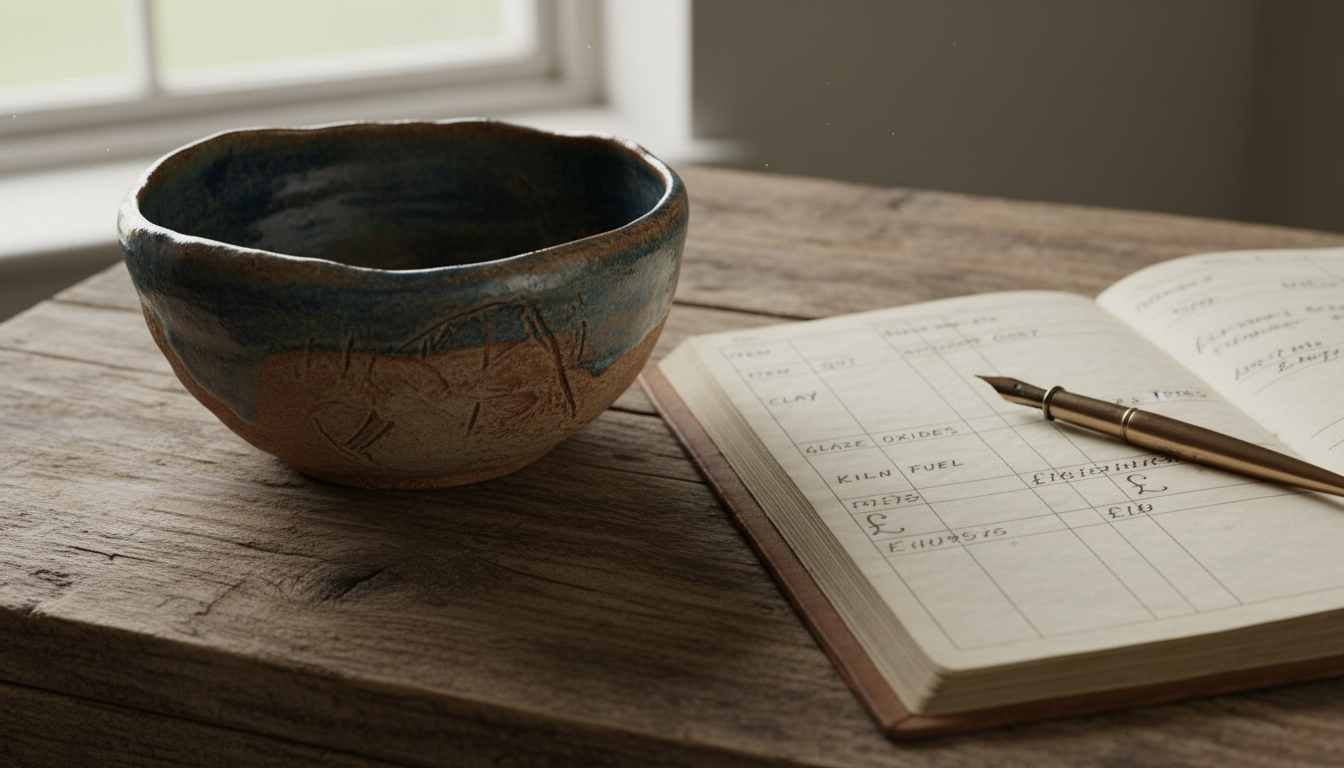
Before you can determine profit, you must understand expenditure. Many hobbyists underestimate their “burn rate”—the cost of materials consumed during the creative process. To price with confidence, you must recover these costs fully.
Material Mathematics: The Replacement Cost Principle
A common mistake is calculating costs based on what you paid for materials years ago. In an economy with fluctuating inflation, you must price based on replacement cost. If you used half a tube of Winsor & Newton Professional Watercolour, calculate the cost to buy that tube today, not what it cost in 2019.
The “x2” Rule for Materials:
Subject matter experts recommend a simple buffer: calculate your raw material cost and multiply it by two.
- Why? This covers the “invisible” consumables: the gesso, the varnish, the paper towels, the brush wear-and-tear, and the inevitable waste paint on the palette.
The UK Framing Factor
In the UK market, buyers generally expect a “finished” product. A canvas with messy, stapled sides looks amateurish. A watercolour sold loose in an envelope has a lower perceived value than one in a mount.
- Ready-to-Hang: If you are selling on canvas, ensure the edges are painted (gallery wrap) or framed.
- Framing Costs: If you spend £40 on a bespoke frame, this is a hard cost. It is passed directly to the client. Do not absorb framing costs into your profit margin.
Hidden Logistics and Platform Fees
If you sell online via Etsy UK, Artfinder, or your own website, you are subject to listing fees and transaction percentages (usually 3% to 5% + 20p).
- Card Readers: If you sell at a local craft fair using Zettle or Square, account for the 1.75% transaction fee.
- The “Wet Weather” Packaging Standard: Shipping art in the UK requires specific attention to moisture. Your packaging costs must include waterproof wrapping and heavy-duty cardboard. Budget at least £5–£10 per small parcel for packaging materials alone.
Strategic Pricing Formulas: Leaving the Guesswork Behind
Once you know your costs, you need a formula to determine the value of the art itself. Relying on “gut feeling” leads to inconsistency, which confuses buyers. Choose one of the following methods and stick to it.
Method A: The Hourly Wage Model
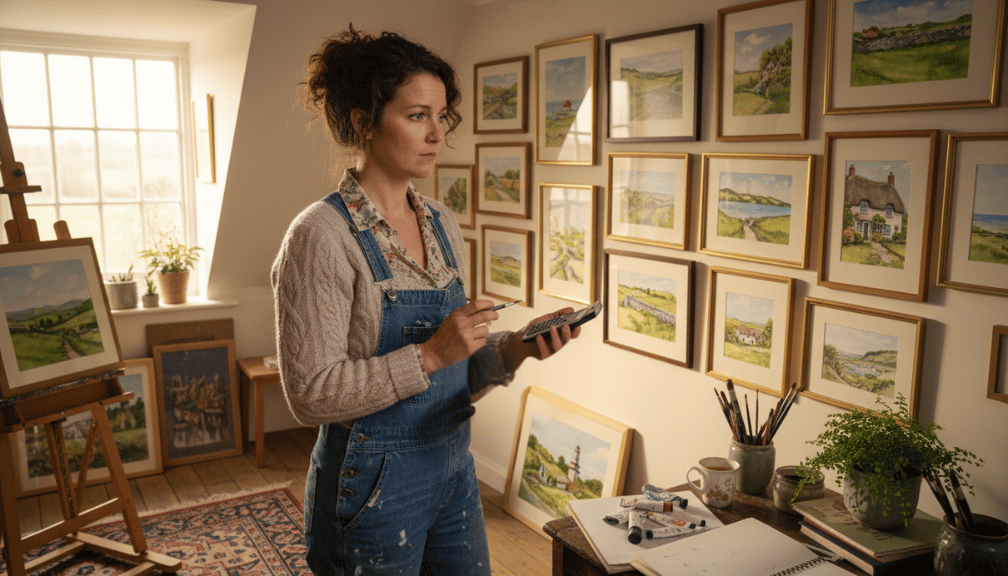
This is the most straightforward method for hobbyists transitioning to semi-professionals. It treats your art practice as skilled labour.
The Formula:
(Hours Spent × Hourly Rate) + (Cost of Materials × 2) = Wholesale Price
Determining Your Rate:
- Minimum Wage is Insufficient: Never price your skilled artistic labour at the UK National Minimum Wage. You are providing a specialized skill.
- The Enthusiast’s Rate: A reasonable starting point for a skilled hobbyist is £15 to £20 per hour. As your demand grows, this rate should increase.
- The Pitfall: This method punishes speed and rewards inefficiency. As you get better, you get faster. You shouldn’t earn less because you have mastered your brushwork.
Method B: The Square Inch (or Centimetre) Method
This is the industry standard for galleries and professional artists. It ensures consistent pricing across different sizes, which builds trust with collectors.
The Formula:
(Width × Height) × Multiplier + (Cost of Materials) = Wholesale Price
Choosing Your Multiplier:
This “magic number” represents your reputation and demand.
- Emerging Hobbyist: £0.50 – £1.00 per square inch (approx £0.08 – £0.15 per sq cm).
- Established Artist: £2.00 – £4.00+ per square inch.
Example Calculation (16″ x 20″ Canvas):
- Size: 16 x 20 = 320 square inches.
- Multiplier: Let’s use £1.50 (mid-level hobbyist).
- Base Art Value: 320 x £1.50 = £480.
- Materials: £40.
- Total Price: £520.
The Hybrid Approach
For many UK hobbyists, a combination works best. Use the Square Inch method as your baseline to ensure your large works are priced logically compared to your small works, but cross-reference it with your Hourly Wage to ensure you aren’t working for pennies on highly detailed, small pieces.
Mirroring the Market: Context is King
Your price cannot exist in a vacuum. It must make sense within the context of where you are selling and who you are selling to.
The “Local vs. London” Divide
The UK has distinct micro-economies for art.
- The Village Hall Standard: If you are selling at a local art society exhibition in a village hall, a price tag of £2,000 may alienate the audience, regardless of the quality.
- The Urban Expectation: Conversely, if you are selling at an art fair in Bristol, Manchester, or London, pricing too low signals a lack of confidence or quality. Buyers in these hubs often equate price with prestige.
The “Red Dot” Strategy
Look at the “Sold” stickers (Red Dots). Visit local galleries, open studios, and check sold listings on Etsy UK filtering for artists with similar skill levels.
- Do not compare yourself to Picasso. Compare yourself to the artist in the next town who paints similar subjects.
- Objective Analysis: If their 12×12 inch landscape sells consistently for £250, and yours is priced at £95, you are undercutting the market and devaluing your work. If yours is £600, you may be overestimating your current reach.
UK Legalities and Logistics: The Boring (But Vital) Bits
To act like a professional, you must understand the rules of the game in the United Kingdom.
The HMRC Trading Allowance
This is the most important tax rule for UK hobbyists.
- The £1,000 Rule: You have a Tax-Free Trading Allowance of £1,000 per tax year. This applies to gross income (total sales), not profit.
- Implication: If you sell a few paintings a year and your total sales are under £1,000, you generally do not need to register with HMRC or file a tax return for this income.
- Exceeding the Limit: Once your gross sales exceed £1,000 in a tax year (April 6th to April 5th), you must register as a Sole Trader and file a Self Assessment.
Understanding Gallery Commissions
If you approach a gallery, be prepared for the “50% split.”
- The Maths: If you need £200 in your pocket to cover costs and time, the gallery price must be £400.
- VAT Considerations: Professional galleries charge VAT on their commission. Ask specifically: “Is the commission 50% including VAT, or 50% plus VAT?” This small detail can eat into your earnings significantly.
Shipping Insurance
Royal Mail has strict exclusions regarding artwork.
- Standard Post: Often does not cover “works of art” for compensation if lost or damaged.
- Special Delivery: Generally required for valuable items to ensure valid compensation cover.
- Couriers: Companies like ParcelForce or DPD often have specific exclusions for art. always read the “Prohibited and Restricted Items” list before booking. You may need specialized third-party insurance for high-value pieces.
Advanced Strategy: Building “Perceived Value”
Why does one painting sell for £50 and another for £500? Often, it is not the paint—it is the presentation.
The Certificate of Authenticity (CoA)
A simple, printed document can instantly elevate your work from “decoration” to “asset.”
- What to include: Title, Medium, Dimensions, Date, Your Signature, and a Thumbnail Image of the work.
- Paper Quality: Print this on heavy, textured card stock. It signals to the buyer that they are purchasing an original, collectible item.
The “Story” Sells
Art enthusiasts do not just buy an object; they buy a connection to the artist.
- The blurb: Never just write “Oil on Canvas, £200.”
- The narrative: Write 3-4 sentences about why you painted it. Was it the light in the Lake District? The mood of a rainy Tuesday? This emotional hook justifies the price.
Price Consistency (The Golden Rule)
You must maintain the same price across all platforms.
- Scenario: A buyer sees your painting in a café for £300. They find your website and see it for £200.
- Result: They feel cheated by the café price or assume the web price implies the work is “cheap.”
- Solution: Your “Retail Price” is fixed. If you sell direct, you keep the full amount. If you sell via a gallery, you pay them their commission from that same retail price.
VI. Common Pitfalls for the Art Enthusiast
1. The “Friends and Family” Discount Trap
While it is kind to offer a discount, repeated deep discounts (50%+) tell your immediate network that your art isn’t “really” worth the sticker price. If you must give a discount, keep it to 10-15% and mark it clearly as a “Family Rate.”
2. Apologetic Pricing
Never apologize for your price. When someone asks, “How much?”, state the figure clearly and fall silent. Do not follow up with, “…but I can take less if that’s too much.” Silence indicates confidence.
3. Ignoring Inflation
If you haven’t raised your prices in two years, you have effectively lowered them. Review your pricing formulas annually in line with UK inflation and the rising cost of art supplies.
VII. Implementation Checklist: Your Action Plan
Ready to put a price tag on your latest creation? Follow this step-by-step workflow.
- Calculate Hard Costs: tally up canvas, paint usage (x2), and framing.
- Apply Your Formula: Calculate the Square Inch or Hourly rate. Add this to your costs.
- Market Check: Does this figure sit comfortably with similar artists in your region?
- Add The Commission Buffer: Ensure the price allows for a 30-50% deduction if a gallery or shop wants to stock it later.
- Final Polish: Create a Certificate of Authenticity and write the “Story” of the piece.
- Publish: List the item with confidence.
VIII. Comprehensive FAQ
Q: I’m just a hobbyist; isn’t it arrogant to charge ‘professional’ prices?
A: No. If your work is of good quality and uses professional materials, underpricing it hurts the entire ecosystem. It undercuts full-time artists and trains buyers to expect art to be cheap. Pricing fairly respects both your own effort and the wider art community.
Q: What if my art doesn’t sell at the price I calculated?
A: Pricing is a hypothesis. If you have shown the work to the right audience (this is key) and it hasn’t sold after 6-12 months, you may need to adjust your “Multiplier.” However, ensure the issue isn’t poor marketing or bad photography before you lower the price.
Q: Should I price prints differently from originals?
A: Absolutely. An original is a one-off asset. A print is a reproduction. A common rule of thumb is that a Limited Edition print should be roughly 10-20% of the price of the original work, depending on the edition size. Open editions should be lower.
Q: How do I handle shipping costs for international buyers?
A: Always quote shipping in addition to the artwork price. Use a service like Transglobal Express to get quotes for shipping from the UK to the USA/Europe. Be clear that the buyer is responsible for any import duties or local taxes (customs fees).
Q: Does the HMRC £1,000 allowance include the cost of materials?
A: The £1,000 allowance applies to your turnover (total money in), not your profit. If you sell £1,200 worth of art, but spent £800 on materials, you cannot use the Trading Allowance. You must register as a Sole Trader and declare the income (paying tax only on the £400 profit).
Conclusion: Value Your Art, Value Yourself
Valuing your artwork is one of the most difficult hurdles for the Art Enthusiast. It requires you to step outside the protective bubble of “it’s just a hobby” and acknowledge that you have created something of worth.
By using the formulas and strategies outlined above, you remove the emotion from the math. You create a structure that allows you to sell with confidence, ensuring that your passion for creation can sustain itself for years to come. Remember: a price tag is not a barrier; it is a badge of honour that says, “I made this, and it matters.”