
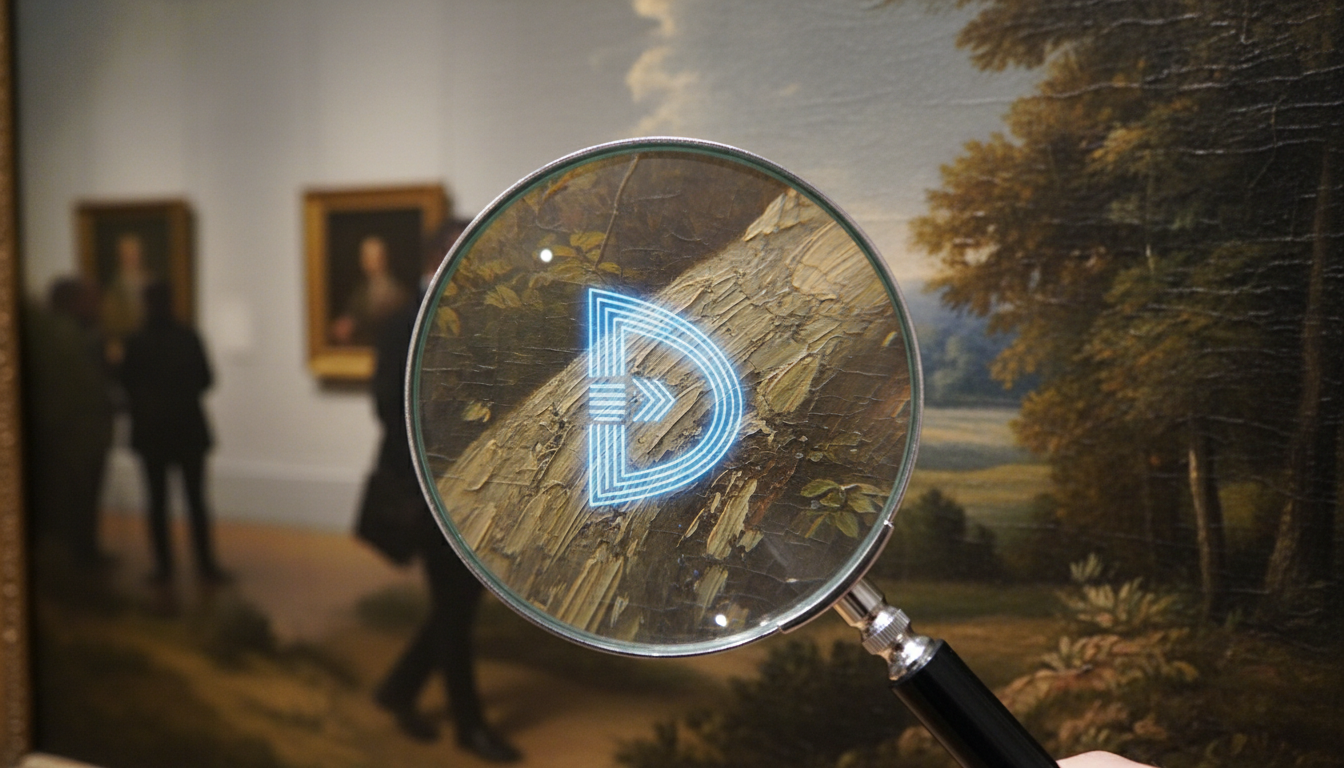
The global art market has undergone a seismic shift. The days when collecting was confined to hushed auction rooms in Mayfair or private viewings in Chelsea are over. Today, the digital art market is a bustling, 24/7 ecosystem where a Ming vase or a mid-century modern print is just a click away. While this democratisation offers unparalleled access to global treasures, it introduces a shadow element that every art enthusiast must confront: the proliferation of sophisticated forgeries.
Estimates suggest that up to 50% of art circulating in the market could be forged or misattributed. For the modern collector, the screen acts as both a window and a barrier. You cannot smell the age of the canvas, feel the texture of the impasto, or examine the oxidation of the frame under a loupe.
However, moving from a hopeful buyer to a diligent collector does not require a degree in art history. It requires a strategic, forensic approach to digital due diligence. This guide serves as your definitive manual for navigating the online marketplace, arming you with the “forensic eye” needed to distinguish a masterpiece from a mimic.
The “Holy Grail”: Understanding Provenance

In the realm of high-stakes collecting, provenance is not merely paperwork; it is the biography of the artwork. It is the single most critical factor in establishing authenticity and value. Provenance refers to the documented history of ownership, tracing the piece from the artist’s studio to the present day.
Decoding the Chain of Custody
When an artwork is listed online, the seller may claim it has “good provenance.” As an enthusiast, you must demand evidence of the chain of custody. A complete chain leaves no period unaccounted for.
- Continuous Ownership: Ideally, you want to see a direct line: Artist $\to$ Gallery $\to$ Collector A $\to$ Auction House $\to$ You.
- The Danger of Gaps: Be wary of descriptions like “Private Collection, Europe (1940-1990).” Large gaps, particularly during the mid-20th century, raise red flags regarding looting during WWII or illicit trade. In the UK and Europe, restitution risks are taken very seriously; purchasing a work with a clouded history can lead to legal forfeiture.
The Evidence Hierarchy
Not all provenance is created equal. When verifying claims online, look for digital scans of the following specific documents:
- Original Gallery Invoices: These should match the date and description of the work.
- Exhibition History: Catalogues or labels indicating the work was displayed publicly.
- Auction Records: Past sales at reputable houses (Sotheby’s, Christie’s, Bonhams) act as a strong vetting mechanism.
Pro Tip: Do not accept a Word document or a simple email summary as proof. You need scans of the original, aged documents.
The Documentation Ecosystem: COAs and Catalogues
A common trap for new collectors is placing blind faith in a “Certificate of Authenticity” (COA). It is vital to understand that a COA is only as valuable as the authority issuing it.
The Truth About Certificates of Authenticity (COA)
In the digital age, anyone with a printer can manufacture a COA. A legitimate COA must come from one of three sources:
- The Artist: Living artists often issue certificates with specific serial numbers or holographic seals.
- The Artist’s Estate/Foundation: For deceased artists (e.g., the Warhol Foundation or the Picasso Administration), these are the only bodies with the legal standing to authenticate.
- Recognised Experts: A scholar who has published heavily on the specific artist.
If a generic online gallery issues a COA signed by their own “internal expert,” treat it with extreme scepticism. It holds little to no weight in the secondary market.
The Catalogue Raisonné Authority
The catalogue raisonné is the ultimate scholarly compilation of an artist’s body of work. It is a comprehensive, annotated listing of every known artwork by that artist.
Before purchasing a significant piece, consult the artist’s catalogue raisonné (many are now available online or in reference libraries).
- If the work is listed: It is almost certainly authentic.
- If the work is missing: It is likely a fake, a copy, or a “rediscovered” work that requires massive scrutiny.
- Reference Numbers: A legitimate listing will often cite the catalogue number (e.g., “Zervos Vol. 2, No. 34”). Cross-reference this immediately.
Technical “Tells”: The Forensic Eye (Even via Zoom)
You may not be able to touch the art, but you can still perform a visual forensic analysis using high-resolution imagery. If a seller refuses to provide high-res photos or detailed close-ups, walk away.
The Verso: The Back Tells the Story
For paintings, the verso (back of the canvas/panel) is often more revealing than the front. Forgers focus on the image; they rarely perfect the ageing of the back. Ask for a photo of the back and look for:
- Labels: Old gallery stickers, auction stencils, or exhibition numbers. These should look aged, not like fresh stickers on old wood.
- Patina of the Stretcher: The wood of the stretcher bars should show natural oxidation (darkening) consistent with the claimed age.
- Pincer Marks: Canvases were traditionally stretched by hand using pliers, leaving distinct marks on the canvas overlap. Modern factory-stretched canvases lack these.
Material Mismatches and Anachronisms
Anachronisms—elements that do not fit the time period—are the undoing of many fakes.
- Hardware: Does a painting supposedly from 1890 have shiny, modern Phillips-head screws or staples on the back? It should have rusty nails or tacks.
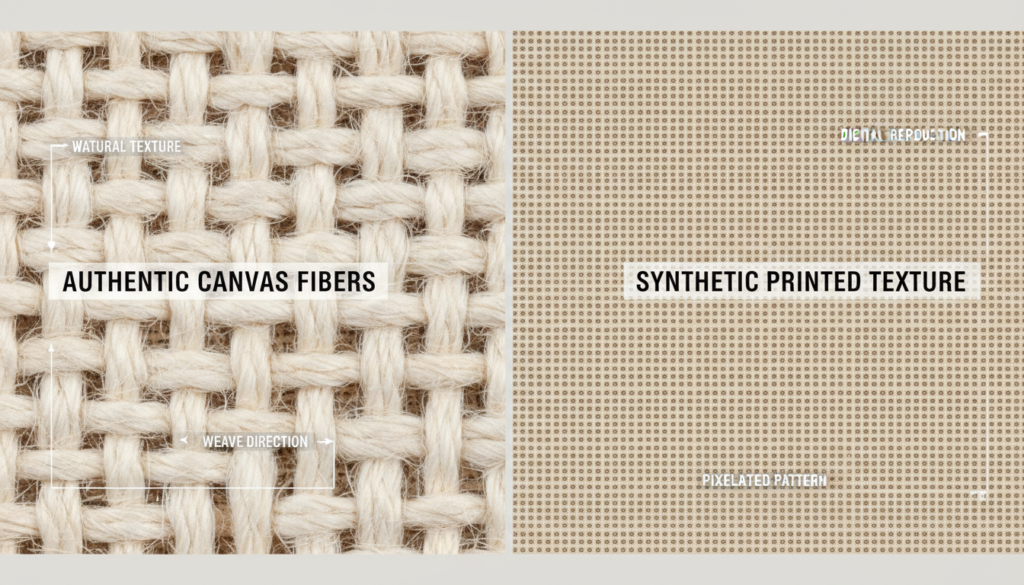
- Craquelure: Old oil paintings develop a network of fine cracks known as craquelure. On fakes, this is sometimes drawn on with a pen or forced chemically. Genuine craquelure follows the stress patterns of the wood and canvas; it should look random and organic, not uniform.
The Signature Trap
Do not rely on the signature. It is the easiest element to forge and the last thing an expert looks at. A signature that looks “too fresh,” sits on top of the varnish rather than under it, or appears shaky compared to known examples is a major warning sign.
Digital Due Diligence: Vetting the Seller
In online art sales, you are buying the seller as much as the object. A reputable dealer mitigates risk; an anonymous seller amplifies it.
Reverse Image Search
Use tools like Google Lens, TinEye, or Yandex to perform a reverse image search on the artwork.
- What to look for: Does the same image appear on AliExpress, eBay, and a high-end gallery site simultaneously? This suggests a mass-produced print being passed off as an original.
- Previous Sales: You might find the image in a past auction catalogue with a much lower price or different attribution (e.g., listed as “Style of” rather than “By”).
Assessing the Digital Footprint
Investigate the seller’s professional standing.
- Companies House (UK): Is the gallery a registered business? Check their filing history. A company incorporated two months ago selling a “Renoir” is highly suspect.
- Trade Associations: Are they members of reputable bodies such as LAPADA (The Association of Art & Antiques Dealers) or CINOA? These organisations enforce strict codes of conduct.
- Physical Presence: A legitimate online dealer usually has a physical address, even if it is an office rather than a storefront. A “Contact Us” form with no address or phone number is a red flag.
Advanced Strategy: When to Call the Pros
For high-value acquisitions, your own due diligence should be the prelude to professional verification.
The Art Loss Register
Before finalising a purchase of significant value, request a certificate from the Art Loss Register (ALR). This is the world’s largest database of stolen art. Checking against the ALR ensures you are not inadvertently buying a piece that was stolen or is subject to an insurance claim.
Scientific and Condition Reports
If you are investing thousands of pounds, it is reasonable to request a Condition Report from an independent restorer. They can view the work in person on your behalf.
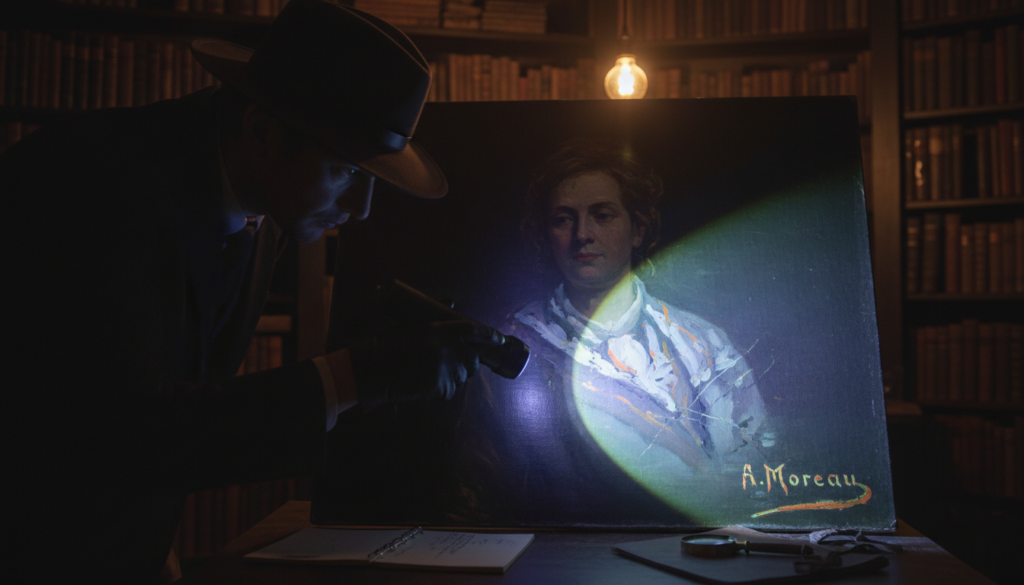
- UV Light Analysis: This reveals overpainting. Under UV light, new paint (restoration or forgery) fluoresces differently from old varnish.
- Pigment Testing: For very high-end works, experts analyse the chemical composition of the paint. For example, if a painting dated 1900 contains Titanium White (mass-produced only after 1921), it is a definitive fake.
UK Consumer Rights and Legal Recourse
Under the Consumer Rights Act 2015, items sold by a UK dealer must be “as described.” If a dealer sells you a painting described as “By Artist X” and it turns out to be a fake, you have legal grounds for a refund. However, this protection applies to sales from traders, not usually private individual sellers. This is why buying from a registered business offers a safety net that buying from “User123” on a forum does not.
Common Mistakes & Pitfalls
Even seasoned collectors can fall prey to psychological traps. Avoid these common errors:
- The “Found Treasure” Fallacy: Believing you have found a masterpiece that the seller is unaware of. In the age of the internet, sellers know what they have. If a Picasso is listed for £500, it is not a mistake; it is a fake.
- Misinterpreting Terminology:
- “Attributed to”: The expert believes it is likely by the artist, but cannot prove it.
- “Studio of”: Created in the artist’s workshop, possibly under supervision, but not by the artist’s hand.
- “Circle of”: A contemporary of the artist, painting in a similar style.
- “After”: A copy of a known work, usually made much later. This is not an original.
- Ignoring the Frame: A frame that looks brand new on an “antique” painting suggests the work was recently framed to hide the edges of a fresh canvas.
Implementation Checklist: The 5-Minute Vetting Protocol
Before you place a bid or click “Buy Now,” run the item through this protocol:
- [ ] Visual Check: Have I seen the back of the artwork (verso)?
- [ ] Image Search: Did I run the main image through Google Lens/TinEye?
- [ ] Provenance: Is there a documented history of ownership beyond the current seller?
- [ ] Attribution: Is the work listed as “By [Artist]” or is it qualified with “After,” “Style of,” or “School of”?
- [ ] Seller Audit: Is the seller a registered company or member of a trade body (LAPADA)?
- [ ] Price Reality: Is the price consistent with market value (check Artnet/Artprice), or is it “too good to be true”?
- [ ] Documentation: Is there a COA from a recognised foundation or a reference to a catalogue raisonné?
Comprehensive FAQ
Q: Is it safe to buy art on eBay?
A: eBay can be a treasure trove for decorative art, but it is high-risk for investment-grade pieces. eBay does not authenticate items. If you buy there, focus on sellers with 100% feedback who specialise in art, and ensure you understand the return policy. For higher value items, dedicated platforms like Artsy, 1stDibs, or established auction house apps are safer.
Q: What should I do if I suspect I’ve bought a fake?
A: First, contact the seller immediately. If they are a registered UK dealer, cite the Consumer Rights Act 2015 regarding “misdescribed goods.” If they refuse a refund, getting an independent expert opinion in writing is your next step to support a legal claim or a credit card chargeback dispute.
Q: Can a Certificate of Authenticity (COA) be faked?
A: Yes, easily. A COA is just a piece of paper. Its value is entirely dependent on who signed it. Always verify the signatory. A COA from a gallery that no longer exists or an anonymous appraiser is essentially worthless.
Q: How much does it cost to get a painting authenticated professionally?
A: This varies wildly. A quick opinion based on photos might cost £50–£100, while a full forensic analysis by a top expert or committee can cost £500 to several thousand pounds. Ensure the potential value of the art justifies this expense.
Q: What is the difference between a “print” and a “reproduction”?
A: This is crucial. A Fine Art Print (lithograph, etching, screen print) is an original work of art produced in a limited edition, often signed by the artist. A Reproduction (or giclée) is simply a high-quality poster copy of an existing painting. Reproductions have decorative value only; prints have investment value.
Conclusion
The digital art market offers an exhilarating frontier for the Art Enthusiast. It removes geographical boundaries and opens the doors to a world of aesthetic discovery. However, the onus of verification has shifted from the dealer to the buyer.
By demanding rigorous provenance, understanding the hierarchy of documentation, and employing digital forensic tools, you protect not only your financial investment but the integrity of your collection. Authenticity is the bedrock of art appreciation. Trust your eye, but verify with your head. If a deal feels too perfect, remember: true masterworks are rarely sold in the shadows. Proceed with caution, verify relentlessly, and collect with confidence.