
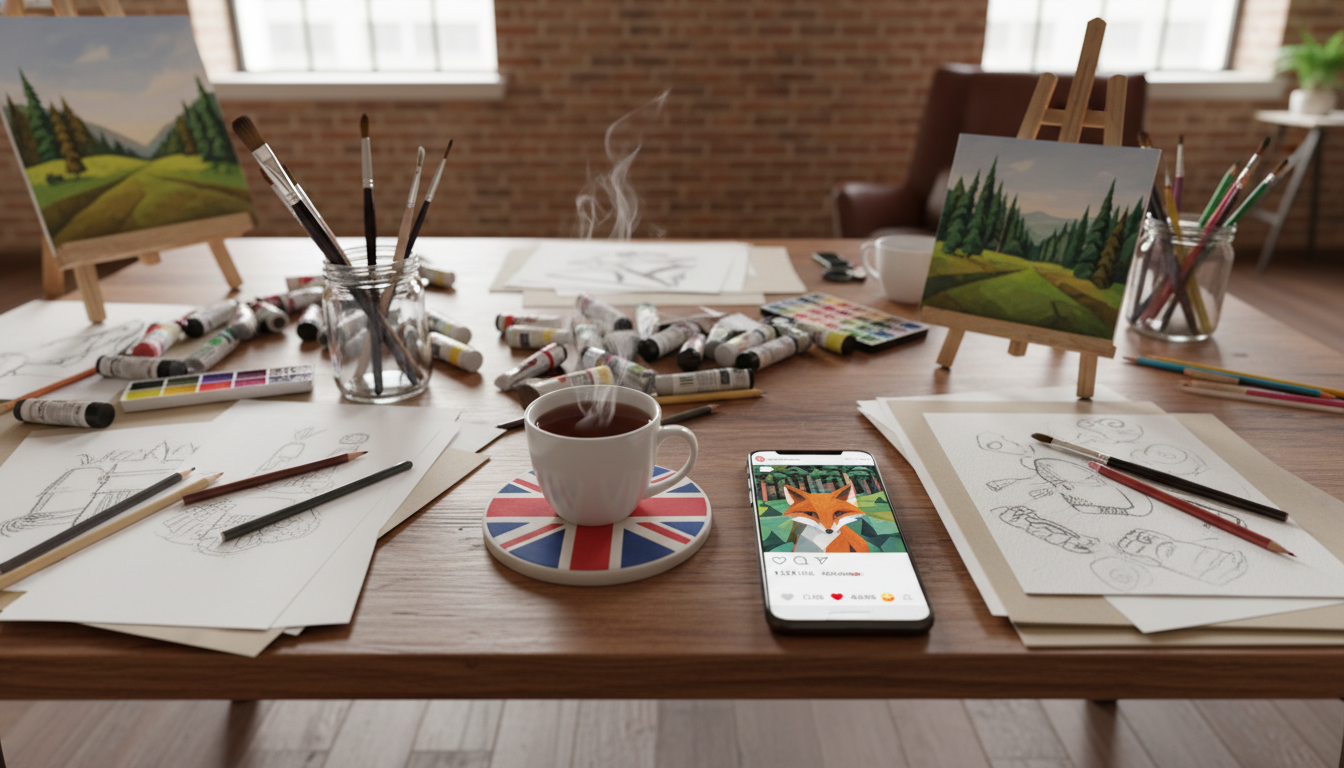
The era of the “starving artist” is effectively over, dismantled by the digital age. However, a new myth has taken its place: the belief that to be a professional artist, you need a sophisticated, expensive ecommerce website. This is categorically false.
For the modern UK-based art enthusiast—whether you are a painter, illustrator, ceramicist, or printmaker—Instagram is not merely a social network; it is a high-traffic virtual gallery, a community hub, and a point-of-sale terminal rolled into one. You do not need to grapple with Shopify coding, Squarespace subscriptions, or WordPress plugins to sell your first, or even your hundredth, masterpiece.
This guide provides a definitive roadmap for selling art on Instagram without a website. We will bypass generic advice and drill down into the specifics of the UK market, covering the nuances of HMRC compliance, Royal Mail logistics, and leveraging payment technologies that make “DM to buy” a seamless professional experience.
Setting Up Your Virtual Gallery: Profile Optimisation
Before you can sell, you must curate. Your Instagram profile is your shopfront. If a potential collector walked into a physical gallery that was cluttered, dimly lit, and lacked pricing, they would leave. Your digital presence requires the same level of curation.
The Business vs. Creator Dilemma
To sell effectively, you must switch your account type from “Personal” to “Professional”. Instagram offers two options here: Business or Creator.
For most artists, the Creator Account is superior. It offers:
- Granular Insights: Understand which artworks trigger the most engagement.
- Flexible Inbox: Separate “General” messages from “Primary” requests (essential for managing sales inquiries).
- Music Library: Access to trending audio for Reels (Business accounts often face copyright restrictions here).
The “Shopfront” Bio
You have 150 characters to convince a visitor to stay. Your bio must answer three questions immediately:
- Who are you? (e.g., Oil Painter based in Bristol)
- What do you sell? (e.g., Atmospheric landscapes & commissions)
- How do they buy? (e.g., DM to claim | UK Shipping Included)
Pro Tip: Use “Highlights” to function as permanent website pages. Create specific highlights for:
- Available Art: A catalogue of unsold work.
- Pricing/FAQ: Clear transparency on costs.
- Reviews: Social proof from happy collectors.
- Shipping: Your packaging process (builds trust).
Beyond Linktree: The “Mini-Site” Strategy
While you don’t have a full website, you still need a landing hub. The “link in bio” is your greatest asset. Instead of a standard Linktree, consider Milkshake or Taplink. These allow you to create visually rich, card-based “mini-sites” that load instantly within Instagram. You can display high-res images of your art with direct payment links, bypassing the need for a domain name entirely.

The UK Legal & Financial Framework
This is the section most “global” guides ignore, yet it is the most critical for your protection. Selling art in the UK triggers specific legal and tax obligations.
HMRC and the £1,000 Trading Allowance
Many hobbyists fear that selling a single painting requires immediate registration as a business. This is incorrect.
Under current UK tax law, you have a Trading Allowance of £1,000. This means you can earn up to £1,000 in gross income (total sales, not just profit) from your art in a tax year without needing to inform HMRC or pay tax on it.
Once your gross income exceeds £1,000, you must register as a Sole Trader for self-assessment. This does not mean you will definitely pay tax (that depends on your total income and personal allowance), but you must declare it.
Consumer Rights Act 2015 & Distance Selling
When you sell online to a consumer in the UK, you are bound by the Consumer Contracts Regulations and the Consumer Rights Act 2015.
Key obligations include:
- Right to Cancel: You must legally offer a 14-day “cooling-off” period. The buyer has 14 days from receiving the art to decide to return it for a full refund (including standard outbound shipping costs).
- “As Described”: Your Instagram photos must be accurate. If a painting is 40cm x 40cm, listing it as “approx 50cm” can lead to a legally valid dispute.
- Damage in Transit: Legally, the artwork is your responsibility until it is in the hands of the buyer. If Royal Mail damages it, you must refund the buyer and then claim compensation from the carrier.
Strategic Insight: State your policies clearly in a “Terms” Highlight. Being transparent about returns actually increases buyer confidence.
Securing the Sale: Payment Infrastructures Without a Cart
The phrase “DM to buy” often scares buyers because it feels unregulated. You need to bridge the gap between a casual chat and a secure transaction. Do not ask for bank transfers via Sort Code and Account Number—it looks unprofessional and risky to new buyers.
Option 1: Payment Links (The Gold Standard)
A payment link is a URL that takes the customer directly to a secure checkout page hosted by a payment processor.
- Stripe Payment Links: Set up a free Stripe account. Create a product (e.g., “Original Canvas 001”), set the price, and generate a link. Send this link in the DM. It supports Apple Pay and Google Pay, which drastically lowers friction.
- PayPal.me: A classic option, but ensure you calculate the fees (roughly 2.9% + 30p). Never ask buyers to use “Friends and Family” to avoid fees; it voids their buyer protection and can get your account banned.
- SumUp / Zettle: popular in the UK for card readers, both these platforms offer “Payment Links” for remote sales. The fees are often competitive (around 2.5%) and funds settle quickly into UK bank accounts.
Option 2: Digital Invoicing for High-Ticket Items
If you are selling a piece for £500+, a payment link might feel too casual. In this case, use a digital invoice.
- Monzo Business / Starling Business: These UK challenger banks allow you to generate professional invoices directly from the app and send them via link or PDF.
- FreeAgent / Xero: If you grow larger, these accounting tools integrate with Instagram sales tracking.
Logistics: Shipping Fine Art in the UK
Shipping is where the profit margin often dies. Mastering Royal Mail and packaging is essential for the UK artist.
The Royal Mail “Click & Drop” Hack
Stop queuing at the Post Office. Create a Royal Mail Click & Drop account.
- Weigh and measure your packaged art at home.
- Buy the postage online (often cheaper than in-branch).
- Print the label (or save the QR code to print at a Delivery Office).
- Drop it off at a parcel postbox or Delivery Office.
Insurance and Service Selection
- Under £50 value: Royal Mail Tracked 48. It provides end-to-end tracking, which is vital for proving delivery to PayPal/Stripe in case of disputes.
- Over £50 value: Do not rely on standard tracking. Use Royal Mail Special Delivery Guaranteed by 1pm. This covers valuables up to £500 (expandable to £2,500). Standard post often excludes “works of art” from compensation, but Special Delivery covers them.
Packaging as Marketing
The “Unboxing” is the final touchpoint of your brand.
- Sustainable Materials: UK art enthusiasts value sustainability. Use paper tape (from suppliers like Kite Packaging) and honeycomb paper wrap instead of plastic bubble wrap.
- The “Thank You” Note: A handwritten note on a branded postcard encourages the buyer to share a photo of the work in their home, tagging you. This is free user-generated content (UGC).
Curating Content that Converts
Posting a photo of a painting is not enough. The algorithm rewards engagement, and buyers buy into the artist, not just the art.
The Content Mix Strategy
Adhere to the 80/20 rule: 80% value/entertainment, 20% hard selling.
- Reels (Reach): This is how new people find you. Focus on “Process Videos”—time-lapses of varnishing, close-ups of brushstrokes, or ASMR mixing paints. Use trending audio but keep the volume low so the art speaks.
- Carousels (Education): Use multi-slide posts to show the artwork in context.
- Slide 1: Full artwork.
- Slide 2: Close-up detail.
- Slide 3: The artwork in a frame (mockup).
- Slide 4: The artwork on a wall (lifestyle shot).
- Stories (Connection & Urgency): This is where sales happen.
- Use the Countdown Sticker 24 hours before a “drop” of new work.
- Use “Polls” to let the audience vote on colour palettes (makes them feel invested in the outcome).
Hashtags and Geo-Tags
Don’t just use #Art. Be specific to the UK scene to attract local collectors who save on shipping.
- Broad: #UKArtist #BritishArt #OilPainting
- Niche: #LondonArtScene #CornwallArtist #AbstractLandscapeUK
- Entity-Specific: #WinsorAndNewton (tagging brands can sometimes get you a repost).
Advanced Strategy: The “Collection Drop” Model
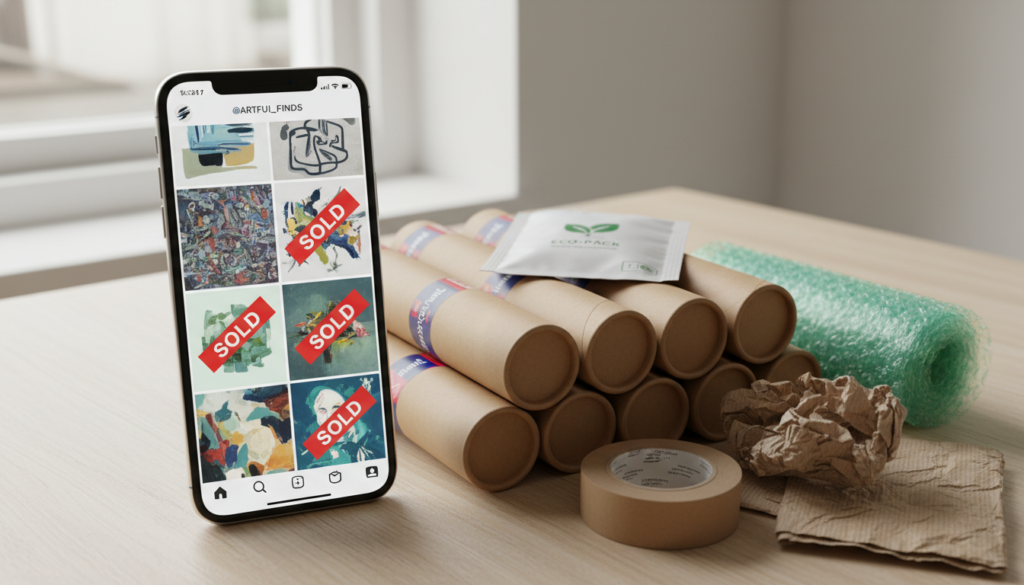
Once you have established a rhythm, move from selling items one-by-one to the “Drop Model”. This creates scarcity and urgency.
How it works:
- Spend 4 weeks creating a cohesive body of work (e.g., 10 paintings).
- Market the collection for the full 4 weeks without selling anything. “Coming Soon.”
- Set a specific launch date and time (e.g., “Friday at 6 PM GMT”).
- On launch day, instruct buyers that sales are “First to DM.”
Why this works: It consolidates all buyer interest into a single moment. The psychological trigger of “fear of missing out” (FOMO) drives faster decision-making. It also simplifies your shipping schedule, as you can pack everything in one weekend.
Pitfalls to Avoid: Common Mistakes
Even talented artists fail on Instagram due to strategic errors.
- The “DM for Price” Frustration: Unless your work is in the thousands of pounds, display the price. Requiring a DM just to know the cost creates friction and anxiety for the buyer. Transparency filters out non-serious buyers and saves you time.
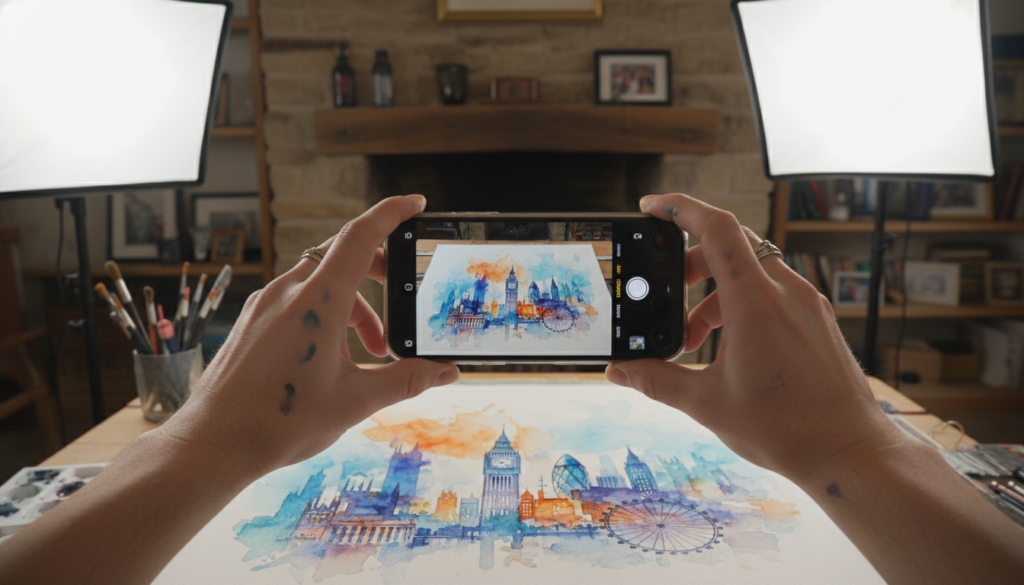
- Poor Lighting: You are selling a visual product. If your photo is yellow-tinted or blurry, the art looks amateur. Photograph your work in natural, indirect daylight (overcast days are best) or invest in a daylight-balanced ring light.
- Ignoring the “Link in Bio”: Sending people to a broken link or a generic homepage kills conversion. Ensure your payment links are active and tested.
- Inconsistent Branding: If your feed is a mix of high-art, blurry dog photos, and political rants, it confuses the customer. Keep the “Grid” curated; put the personal chaos in “Stories” if you must.
Implementation Checklist: Your 7-Day Launch Plan
Ready to turn your hobby into a revenue stream? Follow this sprint.
- Day 1: Switch to a Creator Account. Rewrite your Bio to include “UK Shipping” and a clear CTA.
- Day 2: Sign up for Stripe or SumUp. Generate a test payment link to ensure it works.
- Day 3: Order packaging supplies (rigid mailers, backing boards, paper tape).
- Day 4: Create a “Terms” Highlight covering shipping times and returns (Draft compliant with UK Consumer Rights Act).
- Day 5: Batch create content. Film 3 Reels of your process and photograph 5 pieces of art.
- Day 6: Tease the launch on Stories using a Countdown sticker.
- Day 7: Post your first “For Sale” carousel. Respond to comments immediately.
Frequently Asked Questions (FAQ)
Do I need a business bank account to sell art on Instagram?
Legally, as a Sole Trader in the UK, you are not required to have a business bank account; you can use your personal one. However, it is highly recommended to separate your finances. Many banks (like Starling or Monzo) offer free basic business accounts that make tax returns significantly easier.
How do I handle international shipping from the UK?
If a buyer from the USA or EU wants to buy, you must factor in customs. You must attach a CN22 or CN23 customs declaration (available via Royal Mail Click & Drop). Be clear in your DMs that the buyer is responsible for any import VAT or duties in their country, not you.
What if the buyer claims the art never arrived?
This is why Tracked shipping is non-negotiable. If you used Royal Mail Tracked or Special Delivery, the tracking number is your proof of delivery. If the item is truly lost, you must refund the buyer first, then use your proof of posting to claim compensation from Royal Mail.
Can I sell prints without holding stock?
Yes. You can use a UK-based “Print on Demand” (POD) service like The Print Space or Prodigi. You can connect these to your manual orders: when you get a DM sale, you manually order the print from the lab and have them drop-ship it directly to the customer.
Conclusion
Selling art on Instagram without a website is not a compromise; it is a strategic choice that allows you to remain agile and profitable. By leveraging the tools available to UK creators—from the £1,000 Trading Allowance to Royal Mail’s digital postage solutions and seamless payment links—you can build a thriving art business with zero overheads.
The barrier to entry has never been lower. The only thing missing is your work. Optimise your profile, snap that first high-quality photo, and post. Your collectors are waiting.